
10ml vs 30ml Bacteriostatic Water: What’s the Difference?
Bacteriostatic water is available in several vial sizes, with 10ml and 30ml bacteriostatic water being two commonly searched options. While the main difference may appear to be simply the amount of liquid in the vial, choosing an appropriate size can also affect storage, convenience, cost per millilitre and potential wastage.
In this guide, we compare 10ml vs 30ml bacteriostatic water, explain the practical differences between the two sizes and outline what to consider when purchasing bacteriostatic water in the UK for laboratory use.
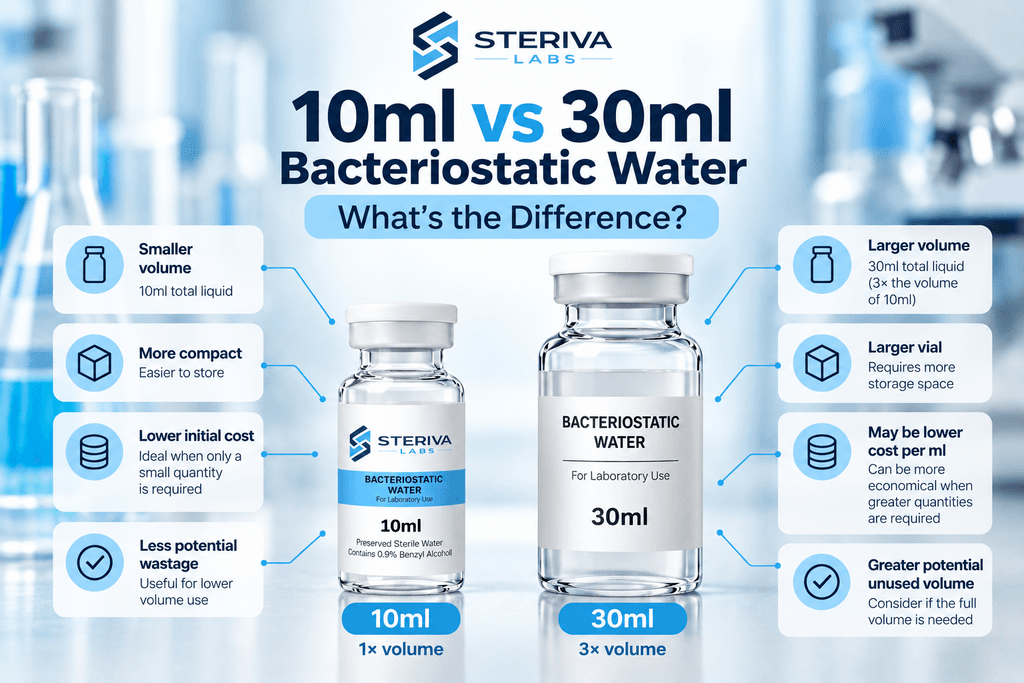
Quick answer: The principal difference between 10ml and 30ml bacteriostatic water is the volume supplied. A 30ml vial contains three times the volume of a 10ml vial. A larger vial is not automatically higher quality or more suitable; the appropriate format depends on the laboratory’s requirements.
10ml vs 30ml Bacteriostatic Water at a Glance
| 10ml Bacteriostatic Water | 30ml Bacteriostatic Water | |
|---|---|---|
| Volume | 10ml | 30ml |
| Total liquid | Smaller volume | 3× the volume of a 10ml vial |
| Storage space | More compact | Larger vial |
| Initial purchase cost | Typically lower | Typically higher |
| Cost per ml | May be higher | May be lower when compared like-for-like |
| Potential unused volume | Lower when only a small quantity is required | Greater if the full volume is not required |
| Best choice | Depends on laboratory requirements | Depends on laboratory requirements |
The volume printed on the vial should not be treated as an indication of quality. Factors such as manufacturing standards, product specification, packaging and independent verification are more useful when assessing a laboratory product.
What Is 10ml Bacteriostatic Water?
10ml bacteriostatic water is supplied in a vial containing 10 millilitres of solution.
Its relatively compact size makes it a practical format when a laboratory does not require the larger quantity supplied by a 30ml vial.
Choosing a smaller vial may also reduce the amount of unused product where only limited volumes are required.
At Steriva Labs, our bacteriostatic water is supplied in 10ml vials and is available individually or in multipacks for customers who require greater overall quantities.
View Steriva Labs 10ml Bacteriostatic Water →
What Is 30ml Bacteriostatic Water?
30ml bacteriostatic water contains three times the liquid volume of a 10ml vial.
The larger format may be convenient in laboratory environments where greater quantities are required. Purchasing a larger vial can also result in a lower price per millilitre depending on the supplier and product.
However, a larger vial does not necessarily represent better value in every situation.
If only a relatively small volume is required, purchasing more product than necessary may simply result in unused solution.
Is 30ml Bacteriostatic Water Better Than 10ml?
Not inherently.
The difference between 10ml and 30ml bacteriostatic water is primarily the quantity supplied rather than one size being universally better than the other.
The most appropriate option depends on factors including:
- The quantity required by the laboratory
- How frequently the product will be used
- Storage requirements
- Supplier pricing
- Whether the additional volume is actually required
- Product specification and quality documentation
For some laboratories, several smaller vials may provide greater flexibility. For others, a larger volume vial may be more convenient.
The important point is to compare more than simply the headline vial size.
Is 30ml Bacteriostatic Water Better Value?
It can have a lower cost per millilitre, but that does not automatically make it the better-value option.
For example, comparing two hypothetical products:
10ml vial at £4.99 = approximately £0.50/ml
30ml vial at £11.99 = approximately £0.40/ml
On a simple price per millilitre calculation, the 30ml vial appears cheaper.
However, if a laboratory only requires 10ml, the additional 20ml provides no financial advantage if it ultimately goes unused.
This is why it can be more useful to consider cost per usable millilitre rather than simply buying the largest available vial.
Steriva Tip: Compare the amount you realistically require alongside the price per millilitre. Buying a larger volume is only economical when the additional volume is actually useful.
Does Vial Size Affect the Quality of Bacteriostatic Water?
No. Vial volume alone does not determine product quality.
A 30ml vial should not be assumed to be higher quality than a 10ml vial simply because it contains more liquid.
When comparing products, more meaningful considerations include:
- Manufacturer information
- Product specification
- Batch information
- Packaging integrity
- Quality control procedures
- Independent testing or verification where available
- Supplier transparency
Steriva Labs publishes information about its approach to product quality on our Testing & Verification page.
Learn about Steriva Labs Testing & Verification →
Storage: Is There a Difference Between 10ml and 30ml?
The larger physical size of a 30ml vial naturally requires more storage space, although this difference may be insignificant for small quantities.
The important consideration is not simply the size of the vial but following the storage instructions supplied with the particular product.
Products should be kept in appropriate conditions and packaging should be inspected before use.
We’ve covered this subject separately in our detailed guide:
How to Store Bacteriostatic Water →
10ml Vials vs One 30ml Vial
Another consideration is whether to purchase multiple 10ml vials or one larger 30ml vial.
Three 10ml vials provide the same total nominal liquid volume as one 30ml vial:
3 × 10ml = 30ml
However, the formats are not necessarily interchangeable from a practical perspective.
Multiple smaller vials allow the total volume to remain divided across separate containers, whereas a single 30ml product keeps the entire volume within one container.
This can make smaller individual vials useful where flexibility and stock management are important.
Pricing should also be compared because multipack discounts can alter the effective price per vial.
Why Does Steriva Labs Supply 10ml Bacteriostatic Water?
Steriva Labs currently supplies bacteriostatic water in 10ml vials.
We selected the 10ml format because it provides a compact individual vial while still allowing customers requiring larger quantities to purchase multipacks.
Steriva bacteriostatic water is currently available as:
1 × 10ml vial
2 × 10ml vials
5 × 10ml vials
10 × 10ml vials
This provides quantities ranging from 10ml to 100ml without requiring all of the solution to be supplied within a single large vial.
View Steriva Labs Bacteriostatic Water →
What Should You Look for When Buying Bacteriostatic Water?
Whether you’re comparing 10ml bacteriostatic water, 30ml bacteriostatic water or multipacks, vial size should only be one part of the purchasing decision.
Look for a supplier that provides clear information about the product, its intended purpose, packaging, specification and quality control processes.
Price is naturally important, but an unusually inexpensive product with very little supporting information may be difficult to evaluate.
For a more detailed purchasing guide, see:
Where to Buy Bacteriostatic Water in the UK →
Frequently Asked Questions
What is the difference between 10ml and 30ml bacteriostatic water?
The primary difference is volume. A 10ml vial contains 10 millilitres, while a 30ml vial contains 30 millilitres, giving the larger vial three times the total liquid volume.
Is 30ml bacteriostatic water better than 10ml?
Not inherently. Vial size determines the quantity supplied rather than the quality of the product. The most appropriate size depends on the quantity required and the product’s specification.
Can you buy 30ml bacteriostatic water in the UK?
30ml bacteriostatic water may be available from some UK or international suppliers. When comparing products, consider the supplier, product specification, documentation, delivery origin and total cost rather than volume alone.
Can I buy 10ml bacteriostatic water in the UK?
Yes. Steriva Labs supplies 10ml bacteriostatic water in the UK in individual vials and multipacks for laboratory use.
Is three 10ml vials the same volume as one 30ml vial?
Yes. Three 10ml vials provide a combined nominal volume of 30ml. However, the liquid is divided between three separate containers rather than being contained in a single vial.
Does vial size affect shelf life?
Vial size alone should not be used to determine shelf life. Always refer to the manufacturer’s product information, expiry information and storage instructions for the specific product.
How should bacteriostatic water be stored?
Storage requirements should follow the instructions supplied with the individual product. See our How to Store Bacteriostatic Water guide for further information.
10ml vs 30ml Bacteriostatic Water: Summary
There is no universal winner when comparing 10ml vs 30ml bacteriostatic water.
A 30ml vial provides three times the liquid volume and may offer a lower price per millilitre. A 10ml vial provides a smaller individual format and may reduce unnecessary excess volume when a larger quantity isn’t required.
For laboratories requiring more than 10ml, another option is purchasing multiple 10ml vials, allowing larger overall quantities to remain divided between separate containers.
Whichever format is selected, vial size should not be treated as an indicator of product quality. Product specification, manufacturing standards, packaging and supplier transparency remain important considerations.
Further Information
Steriva Labs recommends following the product information and storage instructions supplied with each vial.
For further reading, see our guides to What Is Bacteriostatic Water?, How to Store Bacteriostatic Water, Bacteriostatic Water vs Sterile Water, and Where to Buy Bacteriostatic Water in the UK.
For broader information on laboratory quality practices, see the World Health Organization’s Good Practices for Pharmaceutical Quality Control Laboratories, which provides guidance covering quality management, documentation, equipment, materials, testing and laboratory procedures. World Health Organization
WHO – Good Practices for Pharmaceutical Quality Control Laboratories